UML: Class Diagrams
From the behaviour we have already modelled to the system's static structure: the classes, what they hold, and how they connect, read straight out of the requirements.
Move with the arrow keys or the buttons below.
Agenda
Orientation
- Where class diagrams sit among the UML views
- A complete class diagram at a glance
- What they capture; three design approaches
- Reading a class out of the use case and activity
Notation
- Anatomy of a class box
- The visibility markers, and how they really work
- Analysis classes vs design classes
Building and connecting
- Finding classes: noun-verb analysis and judgement calls
- Relationships: association, multiplicity, generalisation, aggregation, association classes
- Dependency, data types and enumerations
Putting it to work
- Good analysis classes; object diagrams
- Back to back: one system as use case, activity and class
- Pitfalls, and how to build one
Where we are: from behaviour to structure
We have built the two behavioural views: the use case diagram (who uses the system and what they can do) and the activity diagram (how one use case flows). The class diagram is the first structural view: the fixed cast of objects the behaviour acts on.
Behaviour (done)
- Use case: the tasks and the actors.
- Activity: the order of steps inside a task.
Structure (here)
- Class: the objects, their data and operations, and how they relate, the long-lived skeleton the behaviour runs on.
- Next: sequence, how those objects message one another over time.
The two views are not separate work: the actors and entities of the use case diagram, the data a use case reads or writes, and the operations it needs all reappear here as classes, attributes and methods.
What a class diagram is, and when to draw it
A class diagram is used when developing an object-oriented system model to show the classes in a system and the associations between them. An object class is a general definition of one kind of system object; an association is a link saying two classes are related. In early analysis, objects represent things in the real world: a patient, a prescription, a doctor, a book.
What it captures
- The classes: each kind of object the system knows about.
- Their attributes (data) and operations (behaviour).
- The associations, with multiplicity, that connect them.
What it does not capture
- The order in which operations run (sequence / activity).
- An object's lifecycle over time (state machine).
- Concurrency, data flow, or where the code is deployed.
It is the longest-lived diagram on most projects: the static structure changes far more slowly than any one flow through it, so it is the artefact teams maintain and design against.
A class diagram at a glance
Before any details, here is a complete class diagram for a small library. Do not decode every symbol yet, the rest of the deck explains each labelled part. Keep returning to this picture: everything that follows is a piece of it.
Four classes (each a box of name / attributes / operations); a generalisation (StaffMember is a LibraryMember, the hollow triangle); an aggregation (a Book has copies, the diamond); an association with multiplicity (a member borrows 0..6 copies); and an association class (Loan, holding the borrow dates). Each one gets its own slide next.
Where the classes come from: three design approaches
Before any class is drawn you decide how to decompose the system. Adel's notes name three classic strategies; analysis-level class modelling usually blends them, but it helps to know which one you are leaning on.
Top-down
Begin with the whole system, split it into subsystems, then into classes. Strong when the high-level architecture is already understood; the risk is inventing classes the requirements never asked for.
Bottom-up
Begin with concrete domain things, a book, a copy, a member, and compose them upward. This is exactly what noun-verb analysis does, and it keeps the model anchored to the requirements text.
Middle-out
Begin with the few central concepts you are sure of, then work outward in both directions. Common in practice when one or two entities (Patient, Loan) clearly anchor the domain.
We work mostly bottom-up from the requirements, using the noun-verb method on the next slides, and sanity-check it against a top-down view of the whole. The goal is classes justified by the text, not by the developer's imagination.
Reading a class out of the other diagrams
A single class box has three compartments, and each maps to something you have already produced. This is the bridge from the behavioural views to the structural one.
Name compartment ← an actor/entity. Attributes ← the data the use cases touch. Operations ← the use cases that object performs. Every part of the class is justified by an earlier model.
Anatomy of a class box, in full notation
Three compartments: name (top), attributes (middle), operations (bottom). Every attribute and operation carries a visibility marker; attributes and parameters carry a type after a colon.
The visibility markers
The marker sits before the member name and records a design decision: who is allowed to touch this member. One BankAccount class shows all five at once.
Default to private data, public operations: the outside calls methods, never reaches into a field. Think of a house, public is the doorbell anyone may ring; private your diary; protected a spare key the family (subclasses) share; package a key the other flats in the building hold; derived your age, computed from the birth date, not stored. Keep it light at analysis level; tighten at design level.
How visibility actually works
Two clarifications make the markers click. Both are exactly how Java, C#, C++ and UML define visibility.
1. It governs code, not people
Visibility says which code (which classes) may use a member; the compiler enforces it. Not about end-users: a Customer is a separate class, limited to an account's public methods.
2. The unit is the class, not the object
private means “any code inside this class, on any object of it”, not just this. So one account can read another's private balance, if that code lives in BankAccount.
The tangible example
class BankAccount {
  - balance: Money                          // private to the class

  + transferTo(other: BankAccount, amt) {
       this.balance  = this.balance  − amt
       other.balance = other.balance + amt   // LEGAL: 'other' is a BankAccount too
  }
}

class StatementPrinter {                     // a different class
  + print(a: BankAccount) {
       a.getBalance()   // OK, getBalance() is public
       a.balance        // COMPILER ERROR, balance is private to BankAccount
  }
}“Can one object touch another's private data?” Yes if they are the same class (the transfer between two BankAccounts); no for any other class, which sees only the public methods.
Analysis classes vs design classes
An analysis class abstracts one or more classes (and sometimes subsystems) of the eventual design. It models the problem domain, not the solution.
An analysis class
- Focuses on functional requirements.
- Defines responsibilities: cohesive subsets of behaviour (the use cases or services it provides to others).
- Defines attributes at a domain level.
- Expresses the relationships it takes part in.
A design class adds
- Full method signatures and parameter / return types.
- Tightened visibility.
- Infrastructure classes (persistence, controllers, factories) and design patterns.
- Navigability and implementation detail.
Phase 3 expects an analysis-level class diagram drawn from your requirements. Reserve the design-level detail (signatures, patterns, infrastructure) for later.
Finding the classes: data-driven noun-verb analysis
The standard recipe (Shlaer and Mellor, late 1980s): identify the data first, group it into classes, then attach behaviour. It keeps the model grounded in the requirements rather than the developer's imagination.
- Read the requirements and underline every noun and noun phrase; collect them as candidate classes.
- Discard the inappropriate candidates (next slide), promoting some to attributes.
- Identify every verb and verb phrase; these are candidate operations.
- Assign each operation to the class responsible for it.
Nouns become classes and attributes; verbs become operations. The noun-verb pairings hint at the associations between classes.
Which nouns to keep, which to discard
Discard a candidate noun if it is
- Redundant, names the same thing as another (member / borrower).
- Omnipotent, a vague "manager" or "system" that would do everything.
- Vague, "information", "data", "item".
- Meta-language, words about the requirements ("feature", "constraint").
- Outside the system scope.
- Really an attribute, "title", "ISBN" belong to Book.
Good classes tend to be (Booch; Shlaer & Mellor)
- Tangible / real-world things: book, copy, course, room.
- Roles: library member, student, doctor, member of staff.
- Events: arrival, departure, request, payment.
- Interactions: meeting, consultation, treatment.
Worked example: the Library, noun analysis
Adel's running example. Underline the nouns in the requirement text, then sift them.
Candidate classes (kept)
Book, BookCopy, Journal, LibraryMember, StaffMember
Discarded / demoted
Library (the system itself), item (vague), three weeks / six / 12 (attributes or rules, not classes).
Which nouns become classes, and the judgement calls
Noun-verb analysis gives candidates, not answers. For each one you argue keep, reject, or it depends, and the reasoning matters more than the verdict. Reasonable modellers differ on the rows marked “debatable”.
| Candidate | Decision | Why, and the alternative you rejected |
|---|---|---|
book | class | The work itself (ISBN, title). Why not merge it with its copies? One title has many physical copies, and you lend a copy, not the title – merging the two loses that distinction. |
copy | class | The physical item on the shelf (barcode, status). Keep only Book and you cannot say which of its three copies is on loan; BookCopy is the fix. |
journal | class (debatable) | Kept separate because journals follow different loan rules (staff only). Alternative: let Book and Journal both specialise an abstract LibraryItem holding the shared loan behaviour – tidier if more item types arrive. |
item | reject, but… | Too vague to be a class itself, yet it is the hint for that LibraryItem superclass. A rejected noun can still shape the model. |
loan / borrowing | association class | It looks like a verb, but it carries its own data (start and return dates) belonging to the member-copy pairing, not to either alone – so it becomes the Loan association class. |
member, staff | class + generalisation | Staff is-a member, so generalisation. Alternative: if one person can be both at once, model a Role rather than a subclass – a genuine design fork. |
library | reject | The system boundary, not a domain object – unless the requirements track several libraries, when it becomes a class after all. |
| three weeks, six, 12 | reject | Loan period and borrowing limits: attributes and constraints (multiplicities), not classes. |
A good class list is defended, not asserted. Be ready to say why BookCopy earns its place and library does not, and to name the alternative you considered – the LibraryItem superclass, the Role class – and why you set it aside.
First-cut analysis class model
The kept nouns become boxes. At this stage they are just named classes; the verb analysis then fills in operations, and the associations come next.
borrow, return, keep track of become operations such as borrow() / return() on the member classes and recordLoan() on the system. Assign each verb to the class responsible for it.
Relationships between classes
Relationships are connections between modelling elements: they describe how objects work together and act as a sanity check on the model. Four kinds carry almost all the weight.
| Relationship | Meaning | Notation |
|---|---|---|
| Association | A persistent link: one class holds, uses or refers to another. | plain line, with multiplicity at each end |
| Generalisation | One class is a more specific kind of another and inherits it (is-a). | solid line, hollow triangle pointing at the parent |
| Aggregation / composition | Part-of: one class is built out of others (part-of). | diamond at the whole, hollow (aggregation) or filled (composition) |
| Dependency | A transient "uses" link: a change in one may affect the other. | dashed line with an open arrowhead |
An association is a relationship between classes; a link is an instance of an association between two specific objects. Adel:LibraryMember linked to copy42:BookCopy is one link of the member-borrows-copy association.
Associations: direction and naming
Name an association with a verb phrase and read it in a direction. Navigability (the arrowhead) says which way access and flow can travel.
A plain association line is bidirectional. An arrowhead makes it unidirectional: the tail class can reach the head class, but not vice versa. Multiplicity sits at each end.
Associations in detail: roles, reflexive links, and instances
An association line can say more than “these two are related”. It can name the role each end plays, and a class can even be associated with itself.
An association connects classes – the type level. A link is one instance of it between two specific objects (Adel: “links instantiate associations”). The class diagram shows the associations; the object diagram (later) shows the links, e.g. sara:Employee manages omar:Employee.
Multiplicity (cardinality)
Multiplicity on an association end answers: how many instances of this class can take part in the relationship at one time?
| Notation | Meaning |
|---|---|
1 | exactly one |
0..1 | optional: zero or one |
* or 0..* | zero or more |
1..* | one or more |
m..n | at least m, at most n (e.g. 0..6, 3..7) |
m | exactly m (e.g. 5, a chessboard has 64 squares) |
In the Library: a LibraryMember borrows 0..6 copies; a BookCopy is borrowed by 0..1 member at a time. Multiplicity is where business rules ("up to six items") enter the static model.
Generalisation (inheritance)
When one class is a more specific kind of another, draw a generalisation: a solid line with a hollow triangle pointing at the parent. The child inherits the parent's attributes, operations and associations, and adds its own.
The triangle always points at the general (parent) class. Use generalisation only for a genuine is-a: a StaffMember is a LibraryMember.
Wrong: “Car is-a Engine”. A car is not a kind of engine; it has one, so that is an association (Car has Engine), not inheritance. Right: “ElectricCar is-a Car”. The test is substitutability: anywhere the code expects a LibraryMember you can hand it a StaffMember and nothing breaks. If the substitution would be absurd (an Engine where a Car is expected), it is not generalisation.
Aggregation and composition (part / whole)
Both say one class is built out of others. They differ in the lifetime of the part: the diamond sits at the whole.
Prefer composition where it fits: aggregation is semantically weak and many tools and reviewers cannot tell it apart from a plain association. Composition has real lifetime bite.
A Course is part of a Programme (aggregation, and a course may sit in more than one programme). An Airplane is made up of Assemblies, each made up of Components – aggregation can recurse. A chessboard is composed of exactly 64 Squares that cannot exist without it – composition, multiplicity 64 on the part end.
Association classes
When an attribute belongs to the relationship rather than to either class, put it on an association class: a class box joined to the association line by a dashed link, sharing the association's name.
mark is not a property of the Student (they have many marks) nor of the Course (it has many) but of the specific Student-takes-Course pairing. A ternary association class does the same for a three-way relationship (e.g. Doctor-Patient-Treatment).
A second domain: the MHC-PMS (patient records)
Adel's other running example, from Sommerville's mental-health-care patient management system. It shows a different shape: one central, attribute-rich class, Consultation, that anchors the whole model.
The most important class in a model is often not the actor but a central event or interaction. Consultation's attributes are the data one consultation records; its operations are what a doctor does during one (prescribe, recordNotes). The two associations read straight from the sentence “a doctor conducts a consultation that a patient attends”.
Dependency, data types and enumerations
Two more notations from richer diagrams. A dependency (dashed open arrow) is a transient "uses" link, weaker than an association. Stereotypes in guillemets label a class's kind.
If an Order holds Products over time, that is an association (solid line). If a method merely takes a Product as an argument or calls it once, that is a dependency (dashed). Dependency is the weakest of the relationships.
An enumeration is a type whose value must be one of a fixed, named list, exactly like an enum in code: a Category is one of Book, Music, Video or Software, and nothing else. A data type is a type with no identity of its own, defined purely by its value: two Money amounts of £5 are interchangeable, whereas two Order objects are distinct even with identical fields. Both are written with a stereotype in guillemets, «like this», to flag that the box is not an ordinary domain class.
What makes a good analysis class
A short checklist that reviews look for. Most weak class models fail on cohesion or coupling.
- Its name reflects its intent.
Prescriptiontells you what it is;ManagerorHelpertells you nothing. - It is a crisp abstraction of one specific element of the problem domain, not several.
- It has a small, defined set of responsibilities, one reason to change.
- High cohesion: it holds only the attributes and operations that genuinely belong together; unrelated ones lower cohesion.
- Low coupling: it has only the associations it truly needs; accidental links raise coupling and spread change.
Most weak models fail one of two ways: an omnipotent class (the “manager” that does everything) has low cohesion; a class wired to almost every other one has high coupling and spreads change. The next slide shows the cohesion failure concretely.
Cohesion: high versus low
Shown, not told. The class on the left does four unrelated jobs; the one on the right does one, with the rest moved to their own classes.
Low cohesion (bad)
Patient
  + name, dateOfBirth
  + register()
  + sendReminderEmail()    // messaging
  + generatePdfReport()    // reporting
  + connectToDatabase()    // persistence
  + calculateInsurance()   // billing
Four unrelated jobs in one class – four reasons to change. Touch the email server and you risk breaking billing.
High cohesion (good)
Patient
  + name, dateOfBirth
  + register()
  + updateContact()

// the rest moved out, to:
NotificationService, ReportGenerator,
PatientRepository, InsuranceCalculator
One job: be a patient. Each other concern lives in its own class. One reason to change.
Count the reasons to change. The left Patient changes whenever email, reporting, persistence or billing changes, four reasons. The right one changes only when what it means to be a patient changes. Fewer reasons to change is higher cohesion.
Object diagrams: a snapshot of instances
Where a class diagram shows the types, an object diagram shows specific instances and the links between them at one moment, a snapshot. Object names are underlined, in the form name : Class.
Object diagrams validate the class model: building a concrete snapshot of real data quickly exposes a missing class, a wrong multiplicity, or an attribute that has nowhere to live.
Back to back: one system, three views (1 of 4)
The three diagrams are not separate exercises. Take a single description and watch the same words drive the use case diagram, then the activity diagram, then the class diagram.
View 1 – the use case diagram: who, and what
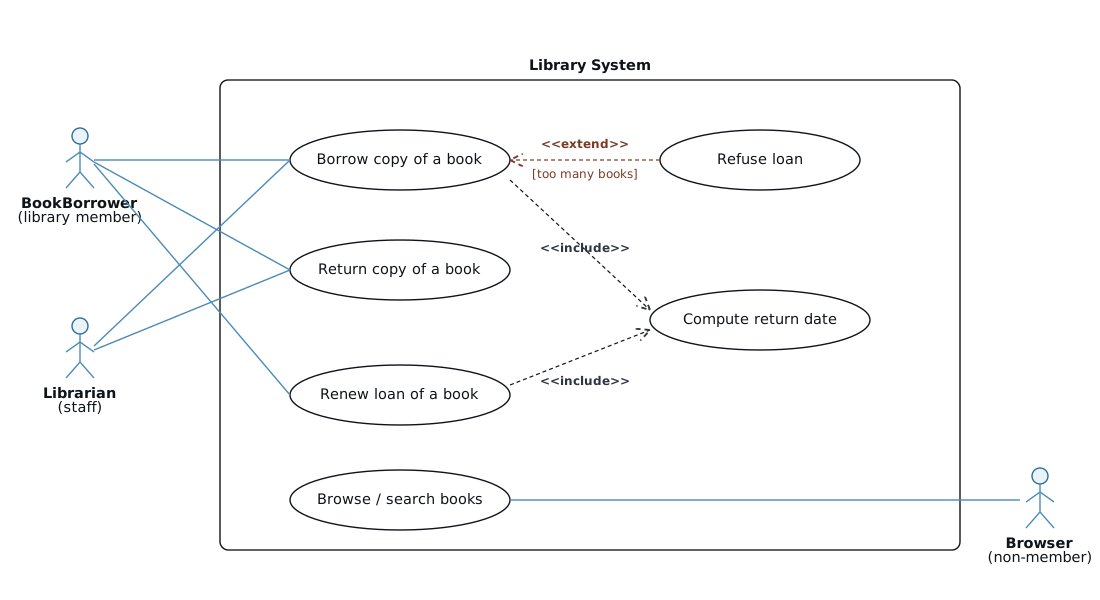
The roles (“member”, “librarian”, anyone browsing) become actors; the things they do (“borrow”, “return”, “renew”, “browse”) become use cases; “compute the return date”, always part of borrowing, is an <<include>>; “refuse a loan when too many”, a conditional, is an <<extend>>.
Walk through the use case diagram
- Three actors sit outside the system boundary: BookBorrower (a member), Librarian (staff), and Browser (a non-member).
- BookBorrower takes part in Borrow, Return and Renew; the Librarian also joins Borrow and Return, since staff hand over and take back the copy.
- A Browser reaches only Browse / search books – no membership required.
- Borrow and Renew each
<<include>>Compute return date: that step always happens as part of them, so it is factored out once. - Refuse loan
<<extend>>s Borrow at the guard[too many books]: it fires only in that case, so it is an optional extension, never part of the normal path.
Back to back: one system, three views (2 of 4)
Pick one use case, Borrow copy of a book, and unpack how it flows. Each action is a verb the system or an actor performs; the swimlanes record who does each.
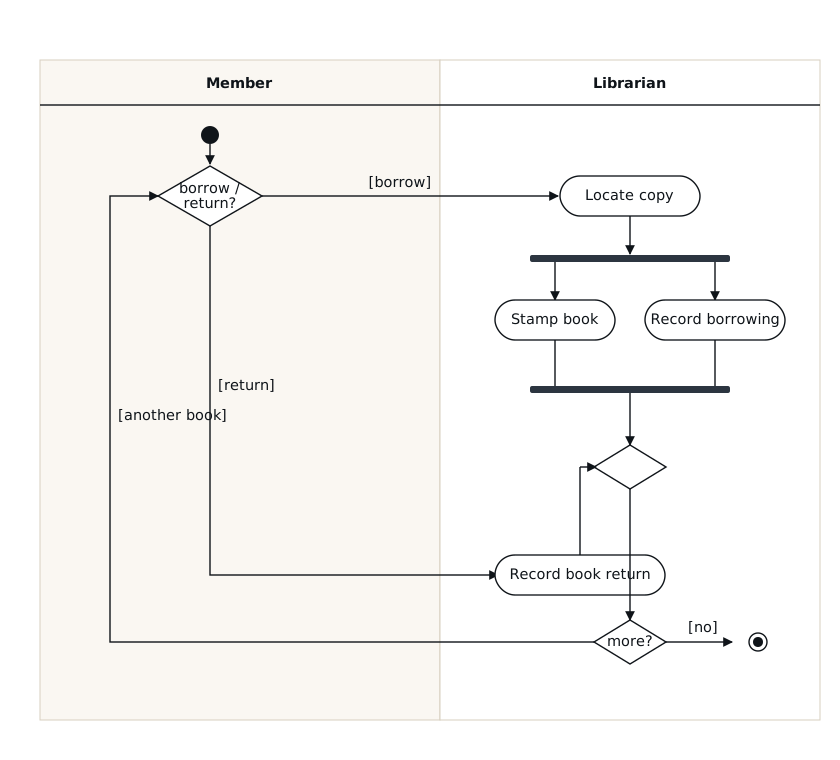
The use case's paths become the activity's actions, decisions and loops (locate, stamp, record, the “more?” loop), and those verbs become operations next. Reading it: the diamonds use named guards ([borrow] / [return], not yes/no); the parallel bars are a fork then join (stamp and record happen together, the join waits); and the plain unlabelled diamond is a merge re-joining the branches, so the decision is closed.
Walk through the activity flow
- Flow starts at the filled dot in the Member lane and reaches the first decision: borrow or return?
- [borrow] crosses into the Librarian lane to Locate copy; then a fork (the bar) runs two actions at once – Stamp book and Record borrowing – and a join (the second bar) waits for both to finish.
- [return] goes straight to Record book return.
- The two branches meet at the plain merge diamond (no guard), which closes the decision, and flow reaches the second decision more?
- [another book] loops back to the first decision; [no] reaches the final node (the bullseye). Every path ends, and every decision is matched by a merge.
Back to back: one system, three views (3 of 4)
This is the diagram from the opening “at a glance” slide, now read against the description. The nouns are classes; the data they hold are attributes; the use cases and activity actions are operations; the noun-verb pairings are the associations.
The nouns become classes (Book, BookCopy, LibraryMember, StaffMember); the data become attributes (ISBN, title, barcode); the verbs become operations (borrow, return, computeReturnDate). “Staff are members” is generalisation; “a book has copies” is aggregation; “a member borrows copies” is the association whose dates live on the Loan association class; “up to six” is the multiplicity 0..6.
Walk through the class diagram
- LibraryMember holds
memberIdandname, and offersregister(). - StaffMember, at the hollow triangle, is a LibraryMember: it inherits everything above and adds
departmentandrole. - Book holds
ISBNandtitle. The diamond on the Book end means a Book is an aggregate of 1..* BookCopy – one title, many physical copies. - BookCopy holds
barcodeandstatus. - The line from LibraryMember to BookCopy is the borrows / returns association: a member borrows
0..6copies; a copy is out to0..1member at a time. - The dashed box Loan is an association class on that line:
startDateandreturnDatedescribe the borrowing, so they belong to neither the member nor the copy alone.
Back to back: one system, three views (4 of 4)
The traceability map. Every diagram element should be answerable to a phrase in the description – this table is how a reviewer, or you, checks that nothing was invented and nothing was dropped.
| Phrase in the description | Use case diagram | Activity diagram | Class diagram |
|---|---|---|---|
| “a library member”, “staff” | BookBorrower, Librarian (actors) | Member, Librarian (swimlanes) | LibraryMember, StaffMember (staff is-a member) |
| “books”, “copies”, “journals” | – (subjects of the use cases) | – (objects acted on) | Book, BookCopy, Journal (Book has 1..* copies) |
| “borrow a copy” | Borrow copy of a book | the borrow branch + its actions | borrow() operation; member–copy association |
| “for three weeks” / “return date” | Compute return date (<<include>>) | action inside the flow | Loan.startDate, returnDate, computeReturnDate() |
| “up to six items” | Refuse loan (<<extend>> [too many]) | a decision guard | multiplicity 0..6 on the borrows association |
| “browse or search” | Browse / search books (Browser actor) | – | a search() operation on the catalogue |
Read each row as one idea traced across all three views. If a class, use case, or action has no row, ask why it exists; if a description phrase has no entry, ask what you missed. That round trip is what makes the models trustworthy rather than decorative, and it is exactly what an examiner checks.
Where class diagrams earn their place
Where they dominate
- All object-oriented code of any real size (Java, C#, Python, TypeScript).
- Domain modelling (Domain-Driven Design).
- ORM mapping (Hibernate, Entity Framework, Django).
- Design patterns, the Gang of Four communicate every pattern as a class diagram.
What they do not solve
- Runtime behaviour, use sequence or state diagrams.
- Data flow, use activity diagrams.
- Concurrency and deployment topology.
A class diagram tells you what exists; nothing about what happens.
Tooling today
- IDEs reverse-engineer them from code.
- PlantUML and Mermaid render them from text in Git workflows.
- Visual Paradigm, Lucidchart, Enterprise Architect do forward and reverse engineering.
Common pitfalls
- Attributes drawn as classes. "Title", "ISBN", "status" are attributes of a class, not classes of their own.
- The omnipotent class. A "SystemManager" that does everything signals analysis stopped too early; split it by responsibility.
- Generalisation where association is meant. Use
is-aonly for genuine specialisation; "has-a" and "part-of" are association and aggregation. - Missing multiplicity. An association end with no multiplicity hides a business rule; always state both ends.
- Aggregation everywhere. If lifetime is not tied, it is a plain association; if it is, prefer composition.
- Mixing analysis and design. Full method signatures, types and infrastructure classes belong to the design-level diagram, not the first cut.
How to build one, and what comes next
Recipe
- From the requirements, the nouns and roles become candidate classes; discard the inappropriate ones.
- Attach the data each holds as attributes; the verbs it owns as operations.
- Draw the associations from the noun-verb pairings; add multiplicity at both ends.
- Add generalisation for
is-a, aggregation / composition forpart-of, association classes for relationship attributes. - Check each class for cohesion and coupling; validate with an object diagram.
Bridge to sequence diagrams
The class diagram tells you what exists; it says nothing about what happens. A call to borrow() on LibraryMember may touch Book, BookCopy, Loan and a persistence store in a specific order, with checks and error returns. That story, messages over time between a fixed cast of objects, is the sequence diagram, next.
Sources: A. Taweel, COMP433 Ch.4 lecture notes; Sommerville, Software Engineering 10th ed.; Booch et al.; Shlaer & Mellor. Companion: COMP433_Ch4_UML_System_Modelling_Companion.html.